
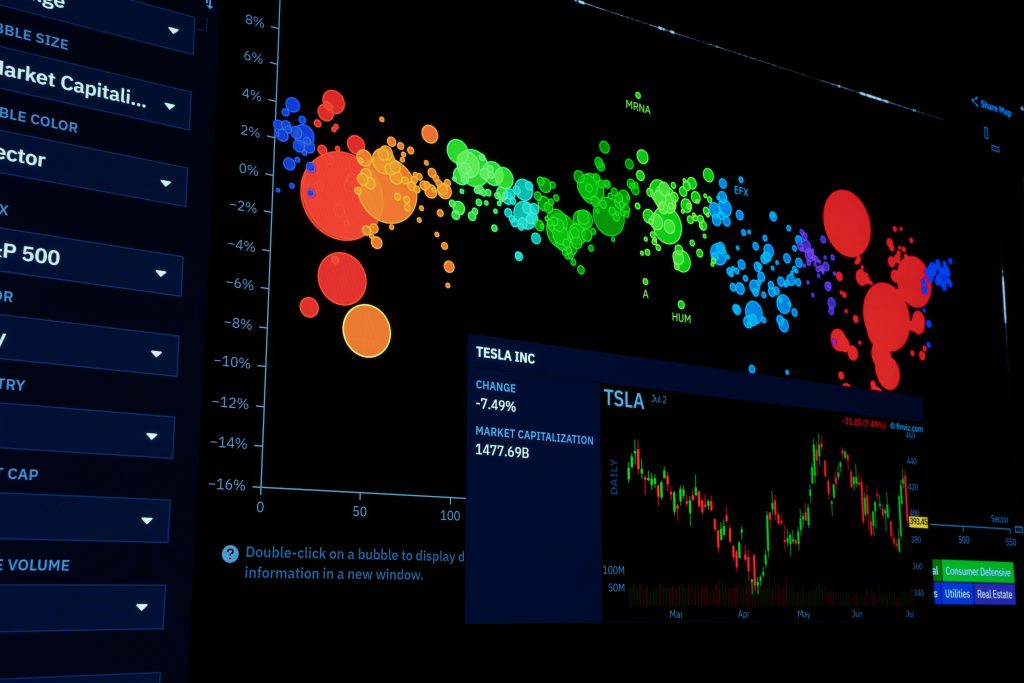
Stock market indices track the performance of a group of stocks that represent a market, sector, or economy. Instead of buying individual company shares, indices trading lets you speculate on the overall direction of that basket. This approach offers broad market exposure in a single trade and is popular among both retail and institutional traders.
What Is an Index?
An index is a statistical measure of the price performance of a selected group of securities. The calculation usually involves market capitalization weighting (larger companies influence the index more) or, less commonly, price weighting or equal weighting.
Well-known examples include:
• S&P 500 – 500 large U.S. companies
• Dow Jones Industrial Average – 30 major U.S. blue-chip stocks
• Nasdaq Composite / Nasdaq-100 – technology-heavy U.S. stocks
• FTSE 100 – leading UK companies
• DAX – major German stocks
• Nikkei 225 – Japanese equities
Indices themselves are not tradable assets. You cannot buy “the S&P 500.” Instead, you trade products that track or derive their value from the index.
How Indices Trading Works
Common ways to trade indices include:
• Contracts for Difference (CFDs) – Popular with retail traders. You speculate on price movements without owning the underlying assets. Positions can be long (bullish) or short (bearish), often with leverage.
• Futures contracts – Standardized agreements to buy or sell the index at a future date and price. Widely used by professionals for hedging and speculation.
• Exchange-traded funds (ETFs) – Funds that hold the underlying stocks or track the index (e.g., SPY for the S&P 500). These are bought and sold like shares and usually involve less leverage.
• Options and other derivatives – Contracts that give the right (but not the obligation) to trade the index at a set price.
Prices of these instruments move in line with the underlying index, though futures and CFDs may show small differences due to financing costs, dividends, or contract specifications.
Key Advantages

• Diversification – One position spreads risk across many companies rather than concentrating it in a single stock.
• Liquidity – Major indices trade with high volume, making entry and exit relatively easy.
• Flexibility – Ability to go long or short and, in many products, use leverage.
• Lower capital requirement (with derivatives) – Leverage allows control of a larger position with less capital.
• Access to global markets – Trade U.S., European, Asian, or sector indices from one account.
Important Risks You Must Understand
• Leverage amplifies losses – A small adverse move can wipe out your margin or produce losses larger than your deposit.
• Volatility – Indices can gap or move sharply on economic data, central-bank decisions, geopolitical events, or company earnings seasons.
• Overnight and financing costs – CFDs and futures often incur daily funding charges or roll costs.
• Tracking error and spreads – The product you trade may not perfectly match the index, and bid-ask spreads add to costs.
• Market and systemic risk – Broad market downturns affect the entire index.
• Counterparty risk – With CFDs, you are exposed to the broker’s solvency.
Never risk money you cannot afford to lose. Leverage is a tool, not a shortcut to profits.
Practical Considerations Before You Start

1. Education first – Understand how indices are calculated, what moves them (interest rates, inflation, employment data, corporate earnings, geopolitical news), and basic technical and fundamental analysis.
2. Choose regulated brokers – Prefer platforms supervised by reputable authorities (e.g., FCA, ASIC, CySEC, NFA/CFTC). Check for segregated client funds and transparent fee structures.
3. Costs matter – Spreads, commissions, overnight financing, and slippage all reduce net returns. Compare total trading costs, not just advertised spreads.
4. Risk management is non-negotiable – Use stop-loss orders, position sizing (risk only a small percentage of capital per trade), and avoid over-leveraging. Decide in advance the maximum loss you will accept.
5. Tax treatment – Gains may be taxed differently depending on whether you trade CFDs, futures, or ETFs and on your jurisdiction. Keep accurate records.
6. Psychological discipline – Indices can trend for long periods or range tightly. Emotional decisions (revenge trading, FOMO) destroy more accounts than bad analysis.
7. Demo practice – Most brokers offer risk-free demo accounts. Use them to test strategies under realistic conditions before committing real capital.
Common Approaches Traders Use
• Trend following on higher timeframes combined with momentum indicators.
• Range trading during low-volatility periods.
• News and event-driven trading around major economic releases.
• Hedging existing equity portfolios with short index positions or put options.
• Pair or relative-value trades between related indices.
No strategy works all the time. Consistent results usually come from robust risk control and adaptation to changing market conditions rather than a “holy grail” system.
Final Thoughts
Indices trading provides an efficient way to gain exposure to entire markets or sectors without picking individual stocks. It offers diversification, liquidity, and the ability to profit in both rising and falling markets. At the same time, leverage, volatility, and costs make it risky, especially for beginners.
Treat it as a serious skill that requires continuous learning, strict risk management, and emotional control. Start small, focus on process over profits, and only increase size once you have a track record of disciplined trading. Understanding the mechanics, the risks, and your own limitations is the foundation of anything sustainable in this space.